
In this article the term porn includes all kinds of lust-inciting content that could be accessed via platforms such as Reddit or Twitter but also more subtle content that platforms like Instagram or Tiktok contain. Non-visually stimulating content like erotic literature or sexually arousing audio is also part of “porn” for the purpose of this article.
Many fellow recovering addicts in F.A.A. are anxious about attending other 12 step fellowships. While F.A.A. provides a unique place for people in recovery from findom addiction to share and be understood, there are no in person meetings (the fellowship is too young/small for this). And while it helps to use your voice rather than type11, the best connections – and as such the best help – is gotten by meeting in person.
You may have shuddered reading that. To attend in person meetings carrying such a heavy topic is scary, even for some who are already attending recovery meetings in other programs such as substance addictions. It is no surprise that opening up about a sex or love addiction is more daunting than doing the same about a substance addiction22. I have heard findom addicts say: “I’m already too scared to share with people the kind of porn I watch, let alone what happened with findom.”
With this article I want to offer those of you who recognize themselves in the above some encouragement, hope, and practical help.
So where to start about attending various established fellowships? Let’s first reflect on what your addictive patterns look like. This will help pinpoint the best match for you. Asking yourself this may help:
- Are my addictive patterns mainly online?
- Do my addictive patterns involve different enablers most every time, or usually the same ones over periods of months or even years?
- Do other kinks serve as gateways into findom, such as: gooning; worship; humiliation?
- Do some online platforms that you don’t specifically use for findom lead you to your addictive patterns?
Your answers will match in varying degrees to the focus of different fellowships. These are ten fellowships that share aspects with findom addiction recovery, in no particular order:
(click the name to go to the website)
PA – Porn Anonymous
What is it: Very focused on pornography addiction – explicitly excludes sexual relations.
Shared aspects: lust, porn.
Good fit if:
– gooning and porn were your addiction long before findom and stayed tightly coupled with it;
– you identify as LGBTQIA+.
PAA – Porn Addicts Anonymous
What is it: The middle ground between S-fellowships and P-fellowships, covering both sex and porn addiction.
Shared aspects: lust, porn.
Good fit if:
– findom was nearly exclusively online and usually mixed with porn.
SPAA – Sex and Porn Addicts Anonymous
What is it: Focused on pornography addiction.
Shared aspects: lust, porn, and sex.
Good fit if:
– findom was nearly exclusively online and usually mixed with porn.
SCA – Sexual Compulsives Anonymous
What is it: Of the S-fellowships this seems (I have not attended this fellowship) to be the most open to all sexual orientations.
Shared aspects: lust, porn, and sex.
Good fit if:
– findom was primarily in-person but also online;
– findom was mixed with porn;
– you identify as LGBTQIA+.
SAA – Sex Addicts Anonymous
What is it: For people addicted to sex, lust, and lust-inciting content.
Shared aspects: lust, porn, and sex.
Good fit if:
– findom was engaged in primarily in-person.
SA – Sexaholics Anonymous
What is it: For people addicted to sex, lust, and lust-inciting content.
Shared aspects: lust, porn, and sex.
Good fit if:
– findom was engaged in primarily in-person.
SLAA – Sex and Love Addicts Anonymous
What is it: For people who find themselves both addicted to love (for instance endlessly returning to toxic relationships) and attention, and to sex or lust.
Shared aspects: lust, porn, emotional-/ co-dependency.
Good fit if:
– findom was engaged in over longer periods (months, years) with the same enablers where some level of bonding happened;
– findom got mixed to some extent with your social life;
– still an equally good fit whether porn was mixed in with findom or not.
LAA – Love Addicts Anonymous
What is it: For those who find themselves endlessly returning to toxic connections and recurringly see their life derailed by romantic interests.
Shared aspects: lust, emotional-/ co-dependency.
Good fit if:
– findom got mixed with your social life;
– findom was engaged in with frequent contact with the same enablers over long periods of time where some bond grew.
GA – Gamblers Anonymous
What is it: I would not recommend this fellowship as your primary meetings. But it can be very useful as an extra meeting to help reflect and broaden your perspective, or for instance when doing 90/90 33.
Shared aspects: financial instability, financial risk taking.
Good fit if:
– the financial aspect of findom is an extreme burden on a daily basis;
– findom caused excessive and meticulous accounting (e.g. lists and budgeting spreadsheets).
ITAA – Internet and Technology Addicts Anonymous
What is it: I would not recommend this fellowship as your primary meetings, but a meeting with ITAA occasionally may help to keep you vigilant on the patterns that lead up to findom relapses.
Shared aspects: isolation, obsessive messaging/social media contact with enablers.
Good fit if:
– you recognise a problem with your smartphone use alongside findom;
– findom led to obsessive use of social media and checking notifications.
There are two noteworthy perspectives you can apply to this list to find what matches best with your patterns of findom addiction: whether findom was engaged in online or in-person, and what the duration and intensity of contact with a single dominant was. The questions above also point to this. The below two scales may help to get a grip more easily on how that relates to these fellowships.
The significance of the aspect of in-person versus online is not simply about how you connected with an enabler or the bond you may have formed. While that can be part of it, it is much more about how it affects the position findom takes in your life or even social circles. Some had vanilla connections turned into findom. Transforming these relationships – or more likely cutting ties with them – poses very different challenges than cutting off enablers who you only talked to online and or anonymously. This is where recoverees in the below first four fellowships will understand your struggles much better than those in P.A.A. or P.A.
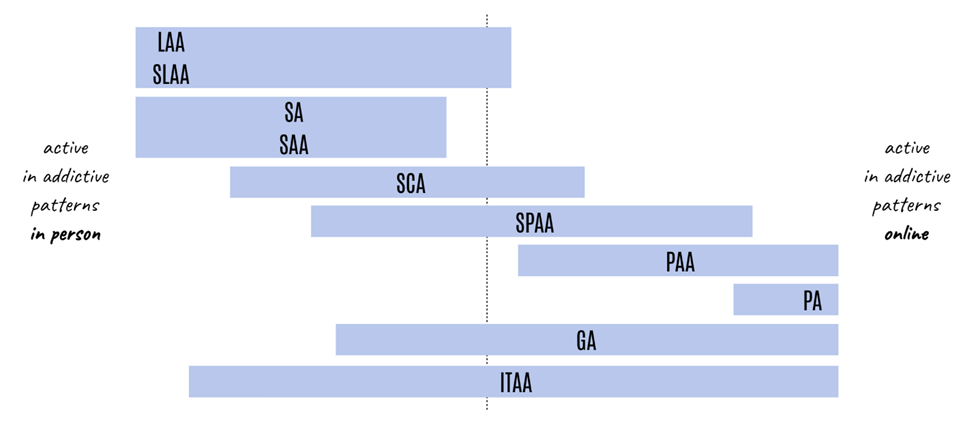
The duration and intensity of contact with enablers matters too. Some turned to a different dominant most every time they engaged in findom. Others engaged with the same dominant frequently for months or years (whether there were others in parallel doesn’t make a difference). This has a much bigger effect on the bond that is formed and/ or the emotional dependency, regardless of whether the contact was in-person or online.
Of course, duration and intensity can be opposites. But the effect is similar. Take whichever is most.
So here are the above fellowships plotted on a scale of the duration and intensity of contact with the same enabler:
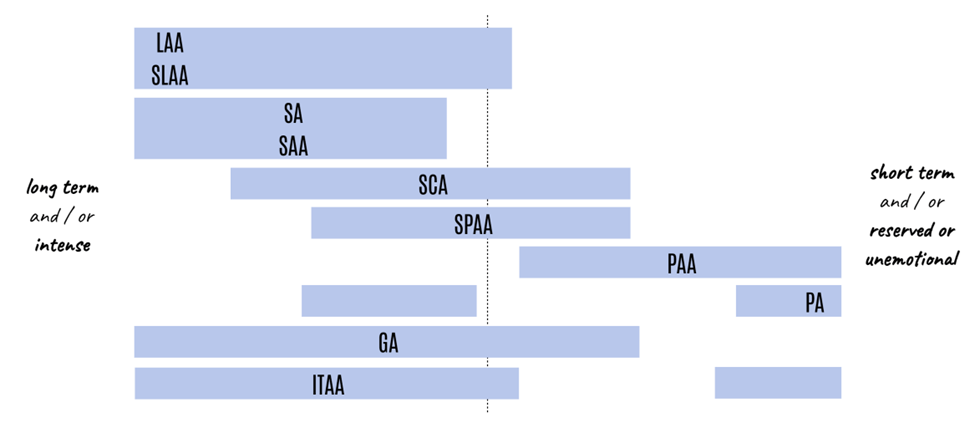
PA is listed on the far end at “short term/ reserved” but also more to the other side. This is because gooning can be very intense on a sensory level and can be both emotionally involved and uninvolved.
ITAA is listed again on the short-term side. Primarily ITAA would be beneficial to people who obsessively checked for updates on a specific person, but ITAA can also apply if checking certain feeds or topics – which can mean short term contact.
Looking at this one might think that addicts who engaged in findom with the same enabler over a long period and in-person are affected the most. I do believe this to be the case overall, but it would be a mistake to see it as a rule: engaging online, short term, unemotional, but frequent and for decades would generally affect someone much more than some months of in-person contact with one enabler.
Hopefully you now have some idea of what fellowship might work for you. But to go attend a meeting…you may be thinking: ”Wait I just wanted to read about this stuff, I don’t want to actually talk to people!”.
I get it, I do. And it isn’t enough to simply see that research shows benefits of sharing in-person. I will try to impart some encouragement and hope.
Firstly, to share in these fellowships about findom is a great opportunity to work with your boundaries. Take it slow, start small. Test the waters and see what you are comfortable with. This evolves from one meeting to the next. Also, fellowships are generally very understanding if you are not sharing much or at all at first. Most specifically state that you are not obliged to share. Some even require that you don’t in your first meeting, or if you relapsed in the past 24 hours. I want to stress again that taking it very slow is absolutely fine. One way you can help yourself if you are anxious in a meeting is to start off your share acknowledging that you are anxious about sharing. This is a gesture of compassion to yourself and enables others to be compassionate with you. Very likely some will share about their own first meetings and how anxious they were. And voilá: you have found common ground already!
Maybe you attend some meetings without sharing, and perhaps feel discouraged because you felt like you should have shared. Stick with it for a while. It does get better. A lot of fellowships acknowledge that it takes time. Usually, they will offer only one advice to you as a newcomer: to attend several meetings before deciding if this is for you. And with good reason, because over time you start to spot more similarities between yourself and others. This could not all happen in the first meeting.
Over time, as you get more comfortable sharing, you may feel enough at ease to get a bit more specific. If you do this without context you may feel a distance between yourself and the group. This will likely be because the others have difficulty relating. Providing some context helps others to see and share ways they can relate, and this helps you to connect to the group. For instance, sharing that you were dominated online and ended up spending a lot of money, while very specific, doesn’t say how you ended up in that situation – what drew you to it or what you dealt with afterwards. You could share instead how you felt a constant pull through messages from enablers/dominants and on a lonely evening reached out to them even though you told yourself you would not. This way you have shared aspects that more people can relate to. Aspects which are also arguably more important to share than the specifics of the moment you acted out.
Here are some examples of things a findom addict might share, in the order of “safe” to “open”. See if you spot the ‘evolution’.
“I am drawn to lust when I am under great stress.”
“When I get aroused, I end up spending a lot of money.”
“My addiction has had me sexualising losing money.”
“My acting out partners are dominant people.”
“My acting out behaviour involves a powerplay around money.”
“My addiction is a bdsm kink.”
“My addiction is a bdsm powerplay where I hand over money to dominant people.”
“I’m submissive when I act out and seek out people to financially abuse me and have me doing immoral acts.”
Perhaps surprisingly, some people in most of these fellowships will relate especially to the last example. They may not dare to share about it themselves, because even sex addicts feel taboo around submission and dominance and immoral things they may have done. But take for instance homewrecking kink (which is often coupled with financial domination): this is a scene not at all uncommon to play out with sex workers. Vanilla people will often be unaware that this is (also) a kink. The same goes for dominance and submission where there is plenty of grey area between whipping someone and keeping someone pressed against the bed.
It is even possible that people in the group will start sharing things they did not previously feel safe to share about, because you bring such vulnerable (and important) topics to the table. That is not hypothetical, it happens. So, it can certainly be argued that whenever you are vulnerable with your share about your findom experiences you are of unique value to the group.
When looking up a meeting it is good to be aware that there can be different types of meetings. Some examples:
- Speaker meeting
Someone with a meaningful recovery journey shares about their life and journey. This means less time for sharing. - Meditation meeting
There is usually less time for sharing. This meeting is focused on maintaining or achieving serenity. - Literature/study/reading meeting
These meetings focus on working through the fellowship’s literature. - Step meeting
In these meetings the literature of one step is read and shared about. This can still be useful to attend as one of your first meetings, though not ideal. - Some meetings are aimed at people in LGBTQIA+ or people with a specific partner relationship status.
If the above is not specified it will be a general meeting. These are the ones you will find most of use when you start out.
Many fellowships have their fellows mentioning their MO or bottom line list (I will discuss bottom lines in more detail in a future article) in introductions. The MO or bottom line is a list of the activities that would constitute a relapse if you engage in them. If you do not have one yet you are free to just say so and skip the list.
Most fellowships have 12 steps based on those of AA and differ only on the first step (where the type of addiction is mentioned). Some fellowships however have entirely different 12 steps. It is good to read before attending.
Fast forward to when you have been attending groups for a few years. You may find yourself kink-friendly even though findom is off limits (I may address this in more detail in a future article). If this turns out to be you, you may benefit from attending Recovery In The Lifestyle (RITL) meetings. Contrary to some previously mentioned fellowships, RITL has extremely open-minded members while still very understanding of various forms of addiction. RITL does not revolve around any specific addiction, rather they are a support network for people who are into the bdsm lifestyle and in recovery from any type of addiction. They hold some in-person meetings (primarily in the US) and have virtual meetings. I mention this fellowship separately because in RITL you are expected to have a primary recovery fellowship. RITL can be a valuable addition from a kink perspective to your primary recovery program.
- Although studies also show that text-based communication can improve self-disclosure, this depends heavily (because of the impersonal nature of the communication) on the willingness of the participants to be honest. Lying is found to occur more in social media than in face-to-face communication. (Markowitz, D.M. Revisiting the Relationship Between Deception and Design: A Replication and Extension of Hancock et al. (2004) 2022.) Emotional connection is also better established via face-to-face and voice-based communication compared to text-based interactions. (Nguyen M, Bin YS, Campbell A. Comparing online and offline self-disclosure: a systematic review 2012.) There are exceptions in cases of autism or general social anxiety. ↩︎
- There is an element of shame in all addictions. Shame in addictions related to sex, however, is compounded by shame that stems from cultural norms that influence a person’s values. (Cooper, S. Is Porn Addiction Really a Disorder? | Psychology Today 2021.) For people addicted to findom, as it is a bdsm kink, shame increases even further due to stigma on bdsm in general. (Hansen-Brown, A.A., Jefferson, S.E. Perceptions of and stigma toward BDSM practitioners 2023.) ↩︎
- 90/90 stands for attending 90 recovery meetings in 90 days. Numerous scientific studies have shown that social support can be critical in addiction recovery. Attending meetings daily for such a period of time keeps the recoveree on alert with respect to avoiding isolation and having accountability. Additionally, receiving encouragement on a daily basis helps to stay motivated. All of these may make all the difference especially early on in recovery, or if the recovery went through a relapse or a series of relapses. The duration is 90 days because this is considered the most critical period. The recoveree experiences the strongest emotions and cravings and is still learning healthier coping skills. ↩︎
 Kurt – Recovery from porn and findom addiction